
Shaping the future role of public relations in management
What does it actually take for communications to be recognised as a strategic management discipline? I’m getting closer to an answer.
Five years ago I set out to answer a question that has occupied me throughout my career: what does it actually take for a communications function to be recognised as a strategic management discipline?
The research grew directly from work I delivered for the Government Communications Service and the NHS during the COVID-19 pandemic, examining the role of professional communications in a crisis of that scale and consequence. It became clear that the conditions under which communications functions operate - how they are positioned, resourced and regarded by management - determined much of their effectiveness. That question has driven the research ever since.
The work has taken me through management literature spanning five decades, a survey of more than 500 UK practitioners, and now a completed set of interviews with some of the most senior communications leaders and their managers working in UK organisations today. The picture is becoming clear.
The theoretical foundations
Management has long understood what excellence looks like. Tom Peters and Robert Waterman identified characteristics of high-performing companies: staying close to the customer, productivity through people, hands-on value-driven leadership.
Jim Collins and Jerry Porras found that enduring success stems from purpose, values and stakeholder relationships. These are areas where public relations can make a strategic contribution.
The Excellence Study, led by James Grunig and colleagues in the 1980s and 1990s, was the first systematic attempt to define excellence specifically within public relations. It established the importance of strategic management, direct reporting to senior leadership, two-way communication, and practitioners occupying managerial rather than purely technical roles. It remains an important foundation, though its snapshot approach and focus on large organisations left gaps.
Those gaps have been addressed, in part, by the European Communication Monitor, conducted annually since 2007 and now the largest study of strategic communication worldwide. From that body of work emerged the Comparative Excellence Framework (CEF), developed by Dejan Verčič, Ansgar Zerfass and Ralph Tench. It identifies six characteristics that distinguish excellent communications functions: talent, alignment, collaboration, listening, measurement and communication strategy.
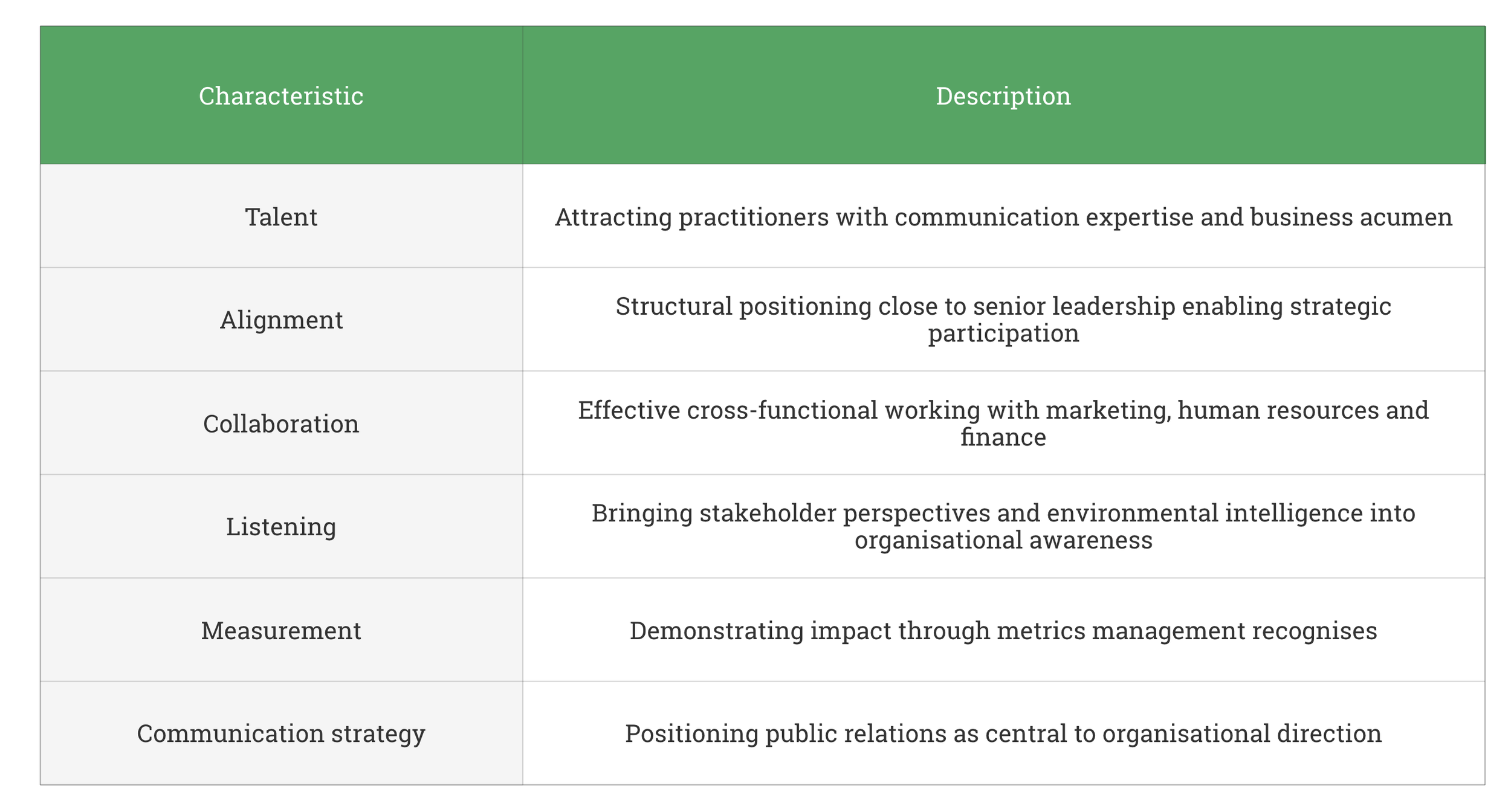
Table: Six characteristics of excellent communication functions (Communication Excellence: How to Develop, Manage and Lead Exceptional Communications)
What the survey found
More than 500 UK in-house practitioners contributed to the survey stage of the research last year, testing the framework against practice in UK organisations. The findings were clear. Collaboration, listening and alignment are areas of relative strength. Communication strategy and talent sit in a second tier. Measurement is the critical weakness - the only characteristic where more practitioners disagreed than agreed that their function performs well.
Measurement also appears to be the gateway to excellence. Among organisations performing strongly across five characteristics, measurement is almost always what is missing. If that challenge were resolved, perfect excellence rates could more than double. Training investment helps across all six characteristics, but even substantial investment leaves measurement weak. It seems to require something more than skill development - potentially a shift in organisational culture and deeper integration with business systems.
The interview stage
Only around one in five communications functions meets excellence criteria across all six dimensions. That means four in five are suboptimal.
Between February and March I conducted dyadic interviews with senior practitioners and their managers - often CEOs and chief communications officers - across NHS trusts, police forces, government departments, regulators, charities, universities and commercial organisations.
The research design pairs practitioners with their managers deliberately. A communications practitioner can describe how they work. Their manager can say whether it makes a difference.
The conversations were among the most rewarding of the entire project. People were generous with their time and candid in ways I hadn't always anticipated. The interview stage is helping me understand how the high-performing fifth got there, and what it takes to stay there.
Impact and the “what next” question
The “what next” question came up a lot at the end of each interview. I want to achieve the standard expected of a PhD project and contribute to knowledge by reporting the findings in peer reviewed journals. But I’m also keen to explore practical applications. A management book and workbook would be good outcomes.
The findings are already feeding directly into the training work I’ve been developing this year. The Communications Management and Leadership one-day course has been running since January. It draws on the same body of thinking: what it actually takes for a communications function to earn strategic recognition, and how practitioners can build the capability to lead at that level.
Two new courses are planned for the next quarter built on the same knowledge base.
The first addresses financial literacy and management for communicators. Understanding budgets, business cases and financial reporting is a prerequisite have for those who want influence at senior level.
The second is an AI course for communicators developed with Ben Verinder, my co-editor of AI for Public Relations: A How-To Guide for Implementation and Management (Kogan Page, 2026). This is a management-level view at what AI means for how communications functions are led, structured and measured.
The months ahead will be spent in the data. But the question driving this work for the past five years has been the same: what does it take for communications to be recognised as a strategic management discipline and what can practitioners do to make that happen?